New Hadamard matrices

Great news: humans have found a Hadamard matrix of order 668
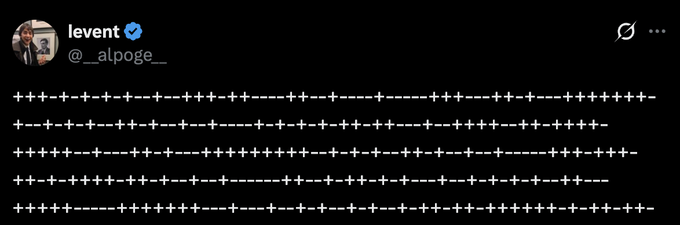
This, and also other Hadamard matrices filling all the gaps up to 2000, have been announced by Levent Alpöge @alpoge . These examples have been obtained by Levent having some “weekend fun w @tehwalris, Saul Reynolds-Haertle, and of course claude:))”.
Some colleagues seem genuinely annoyed by this new form of one-tweet mathematics: you announce a result on X, and the tweet basically is the mathematical object.
My take on this, as of August 2026: I find it pretty cool.
First, it appeals enormously to the geek in me. There is something aesthetically pleasing about opening X and seeing a gigantic wall of + and − signs. It has this old-school Matrix vibe with symbols (0/1s or +/-s) filling the screen.
But beyond the aesthetics, I’m not sure I understand some of the objections.
It’s cryptic. — Is it, though?
You see a huge array of + and − signs posted by the Anthropic mathematician who recently produced the Jacobian counterexample. You know what it is 😅
There’s no proof! — Well… the tweet is the matrix. That’s it.
The claim easy to verify. Save the tweet as a text file, ask Codex to write 20 lines of Python checking that the entries are ±1 and that (HH^T=nI), run it, done. I did this on my phone while waiting in line to buy eclipse glasses.
X is not a place to publish mathematics. — Why not?
Of course arXiv has enormous advantages: permanence, indexing, metadata, versions, etc. Papers are not going away. But X has other properties: it is immediate, extremely easy to share, and widely accessible. If you find an explicit solution to a mathematical problem that fits in a tweet, I don’t see a deep philosophical reason why you shouldn’t post it there. Mathematics existed before journals, and it will survive the occasional result published as a wall of +1 and −1.
There is, however, one criticism I find much more convincing.
How was it found? There’s no explanation!
Mathematics is not only about verifying that the final answer is correct. We care about ideas, mechanisms, proof techniques, failed attempts, constructions, frameworks. It’s about the insight, the understanding, the things that let somebody else “get” the result and perhaps use it elsewhere, improve it, or generalize it.
Clearly, giant matrix tells us almost nothing. People can try to reverse-engineer the construction from the output, but ideally that shouldn’t be necessary. A rough guess is that the recipe involves some combination of:
-
a very strong model,
-
a lot of compute,
-
and a good loopy/agentic harness that in this case is optimizing some measure of “Hadamard-ness” until an exact solution appears.
Pre-LLM mathematics was about the first ingredient in the list. For the rest, Anthropic has all three, most mathematicians do not.
Is that “unfair”? In one sense, obviously: the playing field is not level. Most researchers in academia do not have Anthropic-scale models, engineers and compute at their disposal. But it is also entirely fair to Anthropic: they invested a lot of money and a lot of very smart people into building those capabilities.
What an amazing time to be alive:
we know a Hadamard matrix of order 668 🎉
NB: this article originally appeared on X